
Railway & Transport Club
We meet at 7:30 pm (new time from January 2023) on the 3rd Tuesday of each month, except July, August and December. Contact: John Soer or Jim Dunning.
The Club has over 40 members and enables men and women of all ages to share their common interest.
We meet in the Bradbury Centre of the Methodist Church, in Rose Street (Peach Place), where members enjoy a wide range of good quality presentations on transport topics, including heritage and steam railways, with the opportunity for refreshments and time for a chat.
Future Programme
Note meetings are at 7.30pm in the Bradbury Centre Hall.
| 15 September | ‘The Rise and Demise of the Bus Map’ - John Davies Tonight’s talk is based on John’s recent book “The Rise and Demise of the Bus Map”. This tells the story of Britain’s bus services over the last 120 years or so. Operators took pride in producing high-quality fold-out paper bus maps to promote their services and encourage residents and visitors to use them. Throughout an era of relentless social, political and technological change, bus services and maps evolved and adapted, up to the present day where digital is supplanting the paper map – adding capability, losing some things in the process. |
| 20 October | ‘Southampton Railways’ - Gordon Adams This presentation covers the first hundred years from the three independent companies which built the railways and the development of the Docks by the LSWR and SR. |
| 17 November | Annual General Meeting - followed by Members Evening Bring a selection of up to 20 pictures (preferably in powerpoint format or JPEG) you would like to share. |
Meeting Reports
In March we welcomed back Steve Ollive whose talk this time was “A to Z of Swiss Railways, Part 1”. Steve began by mentioning that although the Swiss Railways had celebrated their 175th Anniversary in 2022, his talk would be based on his travels in 2025. He pointed out that a number of private companies operate alongside the state-controlled company, SSB or CCF or FFS depending on your language. He went on to describe some of the improvements made over the last 60 years such as the introduction of a “clock face timetable”, improved infrastructure and the rebuilding of stations. Steve then went on to show slides of the international freight trains passing through the country. Among other points covered by Steve were the use of double-decker trains and multi-voltage locomotives,
In addition to the state-owned system there are a number of privately owned railway companies operating in Switzerland. The night sleeper from Paddington to Penzance among these is BLS whose many operations include the scenic Lotschberg Railway and the Berne S -Bahn.
Another company is the SOZ Sudostbahn (Southeast Railway) which in addition to its railway operations also runs buses and ferries. Its many railway activities include the Voralpen Express which connects Locarno with Basle and Zurich. Of note among its trains are the Traverso eight-car articulated units.
We look forward to seeing Part 2 of Steve’s presentation in due course.
On 21st April we were entertained by Harry Nethercote who described “My Rail Journeys in 2025”. It would need several pages to fully describe Harry’s travels that year, but some of the highlights were: a trip on the Paddington to Penzance night sleeper; his travels in Cornwall and Devon; a look at the Metro system in Cardiff and steam galas at the Swanage, Severn Valley, Great Central and the Bluebell railways. Another night sleeper took Harry to Glasgow where we saw the new subway trains which have replaced rather old units.
All of this was illustrated not only with slides but also movie clips. What was very noticeable was the wide range of train liveries to be seen around the country. Altogether it had been a most entertaining evening.
Our May meeting saw our Chairman, John Soer, take us on a trip from Leeds to Glasgow to celebrate the 150th anniversary of the opening to passengers on 1st May 1876 of the line from Settle to Carlisle. We started our journey at the locomotive depot at Holbeck to see the variety of engines based there. Then to the main station from where we set out to visit towns such as Shipley, Keighley, Skipton and Hellifield, eventually arriving at Settle Junction.
John explained that the reason for the construction of this line was to enable the Midland Railway to connect the East Midlands and West Yorkshire with Scotland. 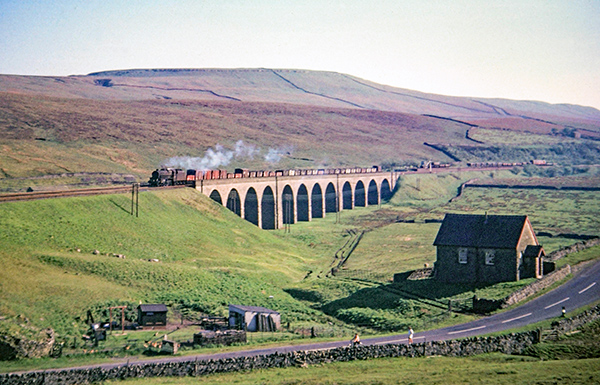 The building of this 72-mile-long line, through some of the wildest countryside in England, involved the construction of 20 viaducts, 14 tunnels and the employment of over 6000 navvies at a cost of £3.6 million. It took 7 years to build. Apart from the financial cost there was a huge human toll; in the construction of the Ribblehead viaduct so many workmen were killed that the Midland Railway paid for an enlargement of the local graveyard. On our journey to Carlisle we saw station buildings, viaducts and some impressive scenery. Of particular note was the fact that the railway company gave permission for church services to be held once a month in the waiting rooms at Ribbleshead and Garsdale.
John Soer
Annual Report (March 2026)
During the past year we have enjoyed a wide-ranging programme of talks with an average attendance of a little over twenty. Some that come are not Church members, but all enjoy the chance to chat to others in a safe environment before the meeting and during the interval. At each meeting old magazines and books are sold, the proceeds being donated to the Railway Children Charity.
John Soer